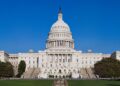


On the south side of Houston sits a 1,600-acre campus where mission control has guided American spaceflight since the 1960s. Last quarter, that campus — NASA’s Johnson Space Center — was tied to one of the largest single federal contract actions with a Texas address: a construction vehicle worth up to $300 million to repair and modernize aging facilities. It barely made the news, which is true of most big federal spending. The dollars are large, the paperwork is dense, and the announcements scroll past without a headline.
Texas takes in a sizable share of federal contract money every year, driven by its military bases, its aerospace footprint, and its defense and IT industrial base. Below are five of the largest contract actions with a Texas connection recorded in recent months, drawn from agency announcements and transaction records in USAspending.gov, the U.S. Treasury’s official spending database. Just as important, we show how you can pull and check these figures yourself, because federal procurement data rewards a careful reader and punishes a careless one.
1. The NASA Johnson Space Center construction contract
NASA awarded a multiple-award construction contract covering campus-wide infrastructure upgrades at Johnson Space Center in Houston, with a ceiling of $300 million spread across several qualified builders. A multiple-award construction contract, or MACC, isn’t a single check to one company. NASA selects several pre-qualified firms upfront, then issues individual task orders as specific projects come up, keeping competitive pressure among the pool. The $300 million is the maximum across all of them, not a guaranteed payout.
The need is well documented. Parts of the Johnson campus date to the Apollo era, and NASA’s Office of Inspector General has repeatedly flagged deferred maintenance and a multibillion-dollar repair backlog across the agency’s centers. For Houston, the contract means construction jobs and a campus that keeps supporting the International Space Station and the Artemis lunar program rather than patching systems long past their service life.
2. The nuclear-weapons plant that actually is in Texas: Pantex
Just outside Amarillo sits Pantex, the nation’s primary nuclear weapon assembly and disassembly site for more than 40 years. In June 2024, the Department of Energy’s National Nuclear Security Administration awarded the plant’s management-and-operating contract to PanTeXas Deterrence, LLC, a joint venture of BWXT Technical Services Group, Fluor Federal Services, SOC LLC, and the Texas A&M University System, following NNSA’s own announcement. The deal runs a five-year base period with three five-year options — up to 20 years and four months if every option is exercised — at an estimated $1.5 billion a year, or roughly $30 billion across the full potential term. The award is recorded on USAspending.gov under contract ID 89233224CNA000004.
This is a genuine Texas place of performance, not a contracting address of convenience: the plant itself sits in Carson County, and the contract explicitly folds in a Texas public university system as a joint-venture partner. It’s also a useful contrast with a common point of confusion. Sandia National Laboratories, one of the other sites in the same national nuclear-security complex, is managed under a similarly massive Honeywell-subsidiary contract — but Sandia’s campuses are in Albuquerque, New Mexico, and Livermore, California, not Texas. Two contracts, same agency family, same nine-figure-and-up scale; only one of them belongs on a Texas list. The lesson is about reading the data: a giant contract number doesn’t mean the work happens where you assume. Always check the “place of performance” field, which the platform documents in its spending guide, before you claim a dollar landed in your state.
3. Defense Logistics Agency fuel contracts
The Defense Logistics Agency handles nearly all of the Pentagon’s fuel purchasing, a portfolio that can top $30 billion in a single year. In one recent DLA Energy award, the agency selected 12 companies for a combined $2.18 billion in fixed-price fuel contracts covering delivery locations across 14 states, Texas included, through an October 2026 ordering period. San Antonio-based Valero Marketing and Supply took the third-largest individual share at $398,582,190, behind Marathon Petroleum ($512,003,911) and Chevron U.S.A. ($420,087,707).
The caveat: this is a nationwide vehicle, and DLA’s notice doesn’t break out how much fuel is actually delivered to Texas bases versus the other 13 states — what’s verifiable is Valero’s specific award figure. Separately, DLA Energy runs a standing fuel-services solicitation for Fort Cavazos, Texas, confirming Texas bases consume this fuel even where one combined figure isn’t published.
4. Defense IT and cybersecurity task orders at Texas bases
Some of these task orders come with real, checkable numbers. STS Government Solutions LLC, a San Antonio firm, won a ceiling $53,470,084 Air Force contract for cyber-defense and network-security support for the 33rd Cyber Operations Squadron, performed at Joint Base San Antonio-Lackland. It drew 127 competing offers and runs through August 2030. Separately, a $4 billion Air Education and Training Command base-operations vehicle awarded to 19 companies covers 11 installations across six states, including Joint Base San Antonio, Sheppard AFB, Laughlin AFB, and Goodfellow AFB — a multi-state ceiling, not a Texas-only figure.
Not every IT dollar is this traceable; contractor names and task-order numbers on some cybersecurity work are partially withheld in public databases. Where a specific, sourced number exists, like the STS award, it belongs in a “largest contracts” list; where it doesn’t, the honest move is to say so rather than round a vague description into a ranking.
5. Veterans Affairs pharmaceutical purchasing that reaches Texas
The VA runs its Pharmaceutical Prime Vendor program through a single nationwide contract held by McKesson Corporation, whose contracting address is Irving, Texas. The contract carries an approximately $61.8 billion ceiling and, per USAspending.gov, roughly $52.5 billion already obligated, supplying every VA medical center and outpatient pharmacy in the country, Texas included.
The same caveat applies here: McKesson’s contracting office sits in Irving, but “place of performance” is every VA facility it serves nationwide, not Texas specifically, and USAspending.gov’s public interface doesn’t isolate a Texas-only delivery value. What’s verifiable is the contractor’s Texas location and the contract’s overall scale — this piece won’t invent a Texas-only figure that doesn’t exist.
What “biggest” really means in contracting
Federal contracting has its own vocabulary, and misunderstanding it is how well-meaning people end up spreading wrong numbers. A “contract” is often not a single check but a vehicle — an agreement that sets a ceiling and a framework, under which the government issues smaller task orders over time. The headline number is the maximum it could ever pay across years and multiple companies, not money already spent, which is why a “$300 million contract” can sit alongside only a few million in actual obligations to date. There’s also a difference between an “obligation” (money legally committed) and an “outlay” (money actually paid). A big modification to an existing long-term deal can show up in a quarter’s data looking like a brand-new mega-award when it’s really just the latest tweak to a decades-old arrangement.
What this money means for everyday Texans
These abstractions land in concrete ways. The Johnson Space Center contract means trade jobs for the Houston area. The Pantex contract anchors thousands of jobs in and around Amarillo for the next two decades if its options run their course. Fuel and IT contracts at Texas installations support uniformed missions and the contractor workforce around bases like Fort Cavazos and Joint Base San Antonio. VA pharmaceutical purchasing circulates federal dollars through Texas medical facilities serving one of the nation’s largest veteran populations.
The flip side: heavy reliance on a handful of large federal contracts can make a regional economy sensitive to budget fights, shutdowns, and procurement delays in Washington. When a continuing resolution stalls new spending, contractors can defer hiring, which ripples out to local payrolls.
How to check these numbers yourself
None of this requires inside access. On USAspending.gov, use the Advanced Search tool, set the place-of-performance filter to Texas, choose “contracts” as the award type, and set the time period you care about. Sort by obligated amount and the largest actions rise to the top. For bulk work, the Custom Award Data Download Center provides CSV extracts — note the Defense Department reports on a delay, so the most recent obligations may not be fully recorded yet.
A few cautions keep you honest: watch for negative numbers, which are de-obligations, not spending; distinguish a contract’s ceiling from dollars actually obligated; and always confirm place of performance before claiming the work happened in Texas.
From Johnson Space Center to your own search bar
Start where this piece started: a $300 million ceiling at Johnson Space Center that funds electricians and project managers in Houston, not a lump-sum check to one company. That distinction — ceiling versus obligation, ceiling versus outlay — applies just as much to Pantex’s genuine Amarillo footprint, Valero’s slice of the DLA fuel award, and the VA’s nationwide pharmacy contract based in Irving. None of that requires taking this article’s word for it: open USAspending.gov’s Advanced Search, filter to Texas place of performance and last quarter’s dates, sort by obligated amount, and the same five contracts — or whichever ones actually top the list by the time you check — will be sitting there in the government’s own numbers.
This article was produced with AI assistance and reviewed by a human editor. Figures are linked to their primary sources; where a claim could not be verified from the public record, we say so.